Our next goal was to go see the Meteora, which are on the main continent. We took a bus back from Nafplio to Athens, and stopped early at the metro. Metro to Syntagma Square, in front of the parliament. Then, the 024 bus to Bus Terminal B, where we hopped on a bus to Trikala. From there we took another bus to Kalambaka.
We did a bit of research for the next day, then went to bed. I have to say I was pretty stoked - this was what I had been waiting for.
Wednesday, July 28, 2010

Greece 2010 - July 16th - Fortress at Sea
Next, we drove out to Monemvasia, which is described by the Lonely Planet as being "the Greek equivalent to France's Mont St-Michel." I'm afraid this didn't mean much to me until Laurence explained that it basically meant a big fortified city on a rock at sea.
Big is the rock, and impressive are the fortifications! In fact, the main fortifications are of comparable size, but the rock in Monemvasia is much bigger, and the stuff looks much older and timeworn.


Big is the rock, and impressive are the fortifications! In fact, the main fortifications are of comparable size, but the rock in Monemvasia is much bigger, and the stuff looks much older and timeworn.

The main square. Fortifications at the top of the rock are visible in the background.

A section of the main street.
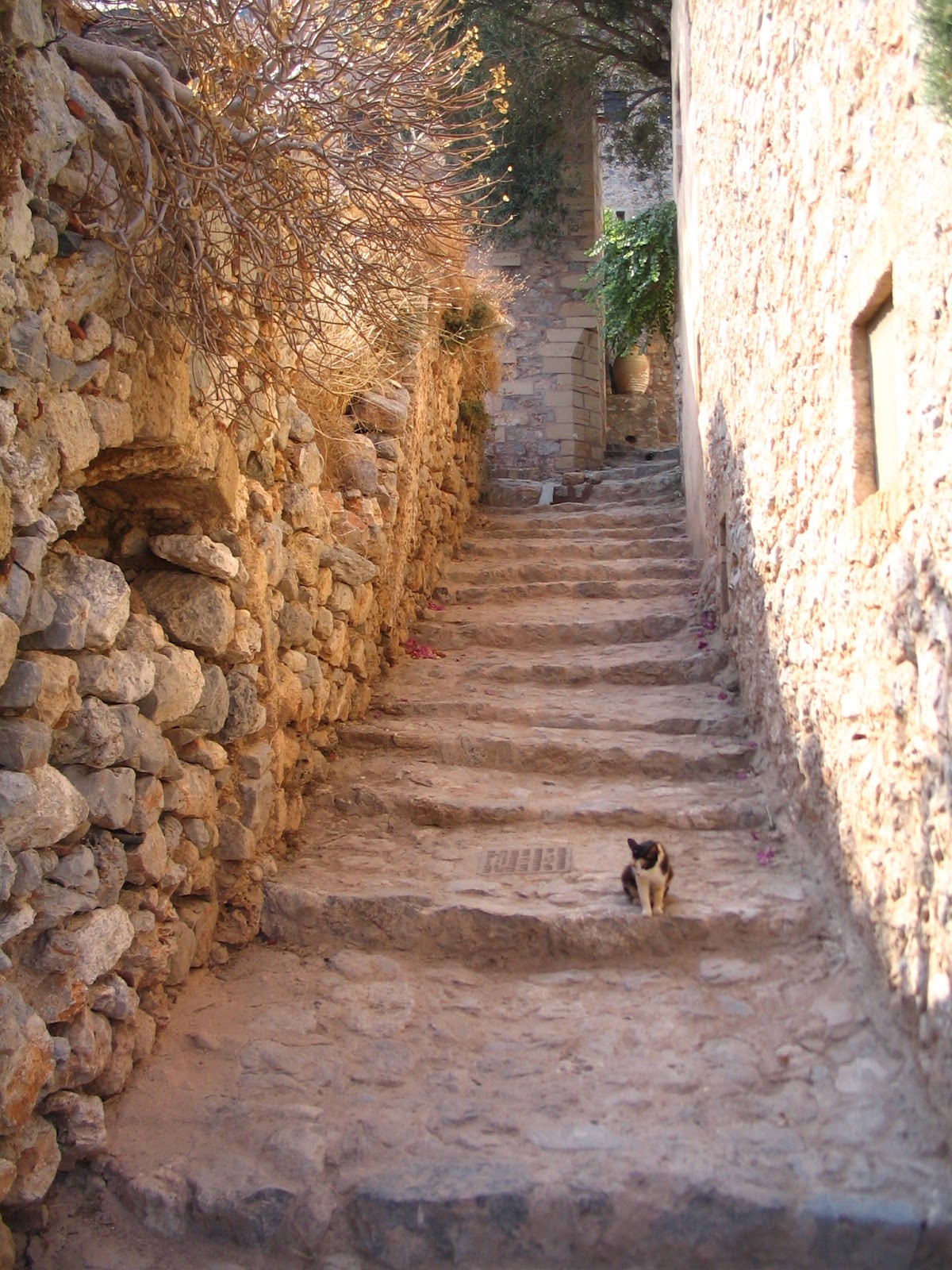
Going up to the ramparts.

Church in the town.
The town has been mostly restored, but if you take the time to climb the stairs and go to the top of the rock, you can see beautiful ruins of a castle, cisterns, and more. There is also another mostly intact/restored church.

Ruins along the wall.

Church of Aghia Sophia, at the top of the hill.

Entrance to the church, from the side.

The background mountain is on the mainland.

Sun setting on the town.

Town from above.

The long way down. Very slippery.

The shorter (but deadlier) way down.

This door has seen better days.
That day was also an occasion to interact with the animal kingdom on multiple bases.
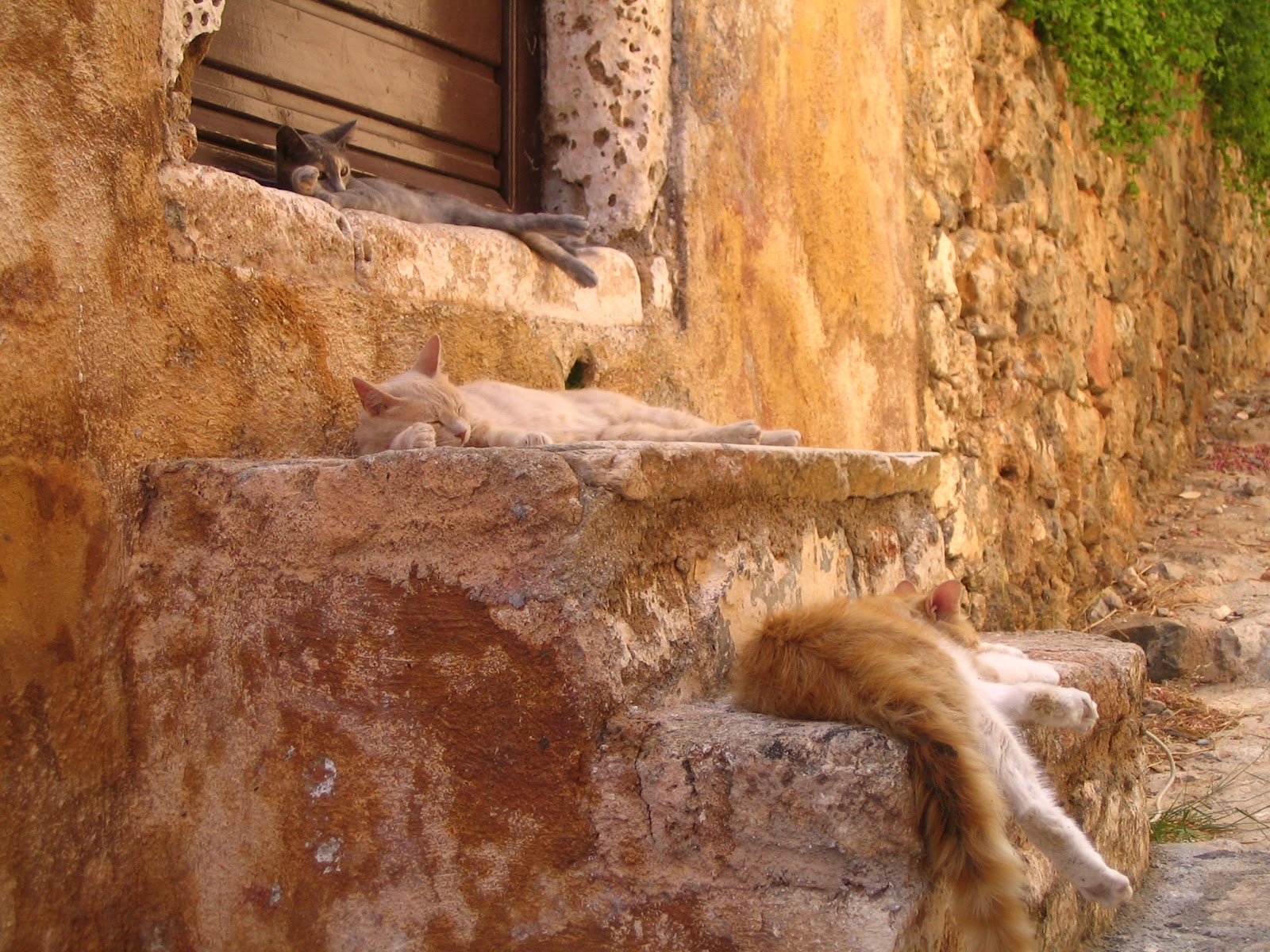
It is that hot.

They make Garfield proud.

Little guy lounging in the shade.

Goats on our way home. They are blocking the road, perhaps to protest something. Shortly after we snapped this picture, a pissed off shepherd dog attempted to take apart our Fiat.
Greece 2010 - July 15th - Olympia
On the 15th, we drove to Olympia. Driving through the country we saw the beautiful village of Langadia, but unfortunately decided we'd take pictures on our way back, thinking we'd catch the sunset - which turned out not to be the case.
Arriving, we headed for the amazing Archaeological Museum of Olympia. It was inspiring to see tangible combat armor, as opposed to the goosed-up versions we see in movies.


We steeled ourselves and left the air-conditioned museum, heading for the site of ancient Olympia.



All told, it was pretty staggering to think of the sheer amount of historical "stuff" that had taken place at Olympia.
Arriving, we headed for the amazing Archaeological Museum of Olympia. It was inspiring to see tangible combat armor, as opposed to the goosed-up versions we see in movies.

Helmets, oldest on the left.

Greaves.

Western pediment of the Temple of Zeus.

Incredible detail.
We steeled ourselves and left the air-conditioned museum, heading for the site of ancient Olympia.

Philippeion.

Stadium. Along the right side you can see the judge's seats around the middle.

Fallen columns by the Temple of Zeus.

Possibly part of the Altar of Oaths.

Bath houses, I believe.
All told, it was pretty staggering to think of the sheer amount of historical "stuff" that had taken place at Olympia.
Greece 2010 - July 14th - Mani
Driving to the Mani on the 14th, we stopped for a brief time in Sparti to check out the statue of Leonidas.

A short drive later, we wound up in the caves of Diros, which are quite something. You are taken on a boat ride over about 1.2km, and then walk about 300 further meters through the cave.


Further south is beautiful Vathia, where people still live in a large fortification. (Their quarters are in the better-preserved portions.)


Heading further south, we planned on hiking to the end of the land in order to scope out a lighthouse. After parking in the nearby town and undertaking a difficult hike and quasi-scramble to a tiny beacon, we decided that the experience wasn't anything like what was described in the Lonely Planet. Everything came to light a moment later as we realized I had taken a wrong turn, bringing us unknowingly to Porto Kagio instead of Kokkinogeia. As luck would have it Porto Kagio also has a trail leading out to the end of the land outcropping where a beacon/lightouse also stands. (Laurence spotted somebody who looked an awful lot like Tilda Swinton on the beach there.)
An hour later we were in the right place. This is the real lighthouse at the end of the Mani:


King Leonidas in butt-kicking regalia.
A short drive later, we wound up in the caves of Diros, which are quite something. You are taken on a boat ride over about 1.2km, and then walk about 300 further meters through the cave.

Caves of Diros.

Caves of Diros.

Caves of Diros.

Caves of Diros.
Further south is beautiful Vathia, where people still live in a large fortification. (Their quarters are in the better-preserved portions.)

Vathia's impressive ruins.

Vathia.

Destroyed accomodations.

Juxtaposition of old and new.
Heading further south, we planned on hiking to the end of the land in order to scope out a lighthouse. After parking in the nearby town and undertaking a difficult hike and quasi-scramble to a tiny beacon, we decided that the experience wasn't anything like what was described in the Lonely Planet. Everything came to light a moment later as we realized I had taken a wrong turn, bringing us unknowingly to Porto Kagio instead of Kokkinogeia. As luck would have it Porto Kagio also has a trail leading out to the end of the land outcropping where a beacon/lightouse also stands. (Laurence spotted somebody who looked an awful lot like Tilda Swinton on the beach there.)
An hour later we were in the right place. This is the real lighthouse at the end of the Mani:

The end of the world.
Greece 2010 - July 13th - Mycenae and Epidavros
Having secured a rental vehicle (Fiat Punto) part-way through the day, we headed off to Mycenae, not too far from Nafplio. It's a fairly large fortified city which was inhabited over multiple periods a good while back in pre-Roman times.


 ^
^


We then gunned it back through Nafplio to get to Epidavros before closing time. Epidavros is known for its theater and its asclepieion, which was a healing center in Classical times.


At this juncture I feel it is appropriate to digress slightly and mention what became a central component of our experience in Greece: the driving. The phenomenon is difficult to summarize, but the word "chaos" comes to mind.
The first thing you notice is that there are many two-wheeled vehicles, and they ride anywhere, everywhere, with the riders usually wearing no protection whatsoever - not even a helmet. They ride and park on sidewalks, between lanes, in parks, on cobblestone streets, you name it. Their scooters are so big (800+ cc) they even get on highways with them. As a corollary, traffic noise is extremely loud.
Cars also park anywhere and everywhere, even where the signs say otherwise. I took this picture on the second day of our trip, but had no clue of its predictive virtues.

That sign is home-made, but even the official ones are most certainly ignored on a wide scale.
On a more general note, everything seems to be dominated by speed:

Lion gate at the entrance to the fortifications.

If I recall correctly, this is a grave circle near the front of the city.
 ^
^
Fortifications near the rear.

Treasury of Atreus, which sits well outside the city and is so large it was never buried by dirt and such.

Fortified city ruins seen from the bottom of the hill.
We then gunned it back through Nafplio to get to Epidavros before closing time. Epidavros is known for its theater and its asclepieion, which was a healing center in Classical times.

Entrance to the theater.

Ruins.

Ruins.
At this juncture I feel it is appropriate to digress slightly and mention what became a central component of our experience in Greece: the driving. The phenomenon is difficult to summarize, but the word "chaos" comes to mind.
The first thing you notice is that there are many two-wheeled vehicles, and they ride anywhere, everywhere, with the riders usually wearing no protection whatsoever - not even a helmet. They ride and park on sidewalks, between lanes, in parks, on cobblestone streets, you name it. Their scooters are so big (800+ cc) they even get on highways with them. As a corollary, traffic noise is extremely loud.
Cars also park anywhere and everywhere, even where the signs say otherwise. I took this picture on the second day of our trip, but had no clue of its predictive virtues.

No parking.
That sign is home-made, but even the official ones are most certainly ignored on a wide scale.
On a more general note, everything seems to be dominated by speed:
- Respecting the speed limits will get you in an accident where you play the role of bowled-over obstacle. Driving through the Mani, we were passed while driving 100 km/h in a 50 km/h zone. My knuckles were white.
- In North America, I feel rebellious when I drive through a stop sign in second gear. In Greece, a stop sign is an opportunity to get read-ended (especially since the signs are often placed in strange locations, i.e. immediately after exiting a highway, giving you very little time to decelerate). Matching traffic, I made it through many stop signs in fourth gear.
- Driving over many hundreds of kilometers over 30+ hours in three in a half days, we found only three distinct traffic light locations.
- Nowhere but in Greece will you spend so much time both well under and well above the speed limit. Well above because, as aforementioned, if you stay at the limit, you are a major hazard, both to yourself and to others; and well under the limit because many small cars are unable to reach the posted limits on the highway, which frequently reach 130 km/h. I drove flat out for miles on end in our little Punto.
Greece 2010 - July 12th - Hitting up the Pelopponese
The next day was about reaching Nafplio, in the Pelopponese. All in all, the day was uneventful, except for a brief stint at Bus Terminal A, which the Lonely Planet describes as "not a good introduction to Athens".
Though Lau remained ever-confident, this was the low point of the trip for me - which is actually a good thing, because I guess it wasn't really that bad. There was much confusion stemming from the physical design of the place - buses parked everywhere in multiple lanes, signs which were difficult to interpret correctly, people milling about and sitting anywhere. Many Greek people were themselves unsure where to go or which bus to get on, which left little hope for tourists who didn't speak the language. In the end, a friendly junk salesman confirmed that we were in the right place, and we were whisked off in a high-tech bus to the Nafplio.
Greece 2010 - July 11th - Blazing Around Paros and Antiparos
Wanting to ride around the island, knowing there were mountains to climb, we rented a 150cc ATV for the day. This made the day possible at all - we never could have covered as much distance, or tackled so much unfriendly terrain, had we opted for something smaller.
Paros has its own acropolis, Koukounaries, from the Mycenaean period. Before the sun got too killer, we hiked up there.


After that, we rode around the island on dirt roads, enjoying the scenery. After a quick boat ride to Antiparos, we kept up the same, and found a small remote beach with strange rock formations.


Paros has its own acropolis, Koukounaries, from the Mycenaean period. Before the sun got too killer, we hiked up there.

Near the top of the acropolis.

Settlements of some sort.

Helios might have been just waking up, but Eol was in full force.
After that, we rode around the island on dirt roads, enjoying the scenery. After a quick boat ride to Antiparos, we kept up the same, and found a small remote beach with strange rock formations.

The beach.

How we got there.

The water was very clear and much less salty than full-on sea water.

Spongy rock. Aero bars are evidently popular in this area of the country.
Subscribe to:
Posts (Atom)